The Official LIONS B2B Summit Report 2026
Discover how creativity is the ultimate lever to secure your place on your clients’ shortlist and gain your position as a trusted B2B partner
Welcome to the LIONS B2B Summit 2026: Where the art and science behind buyability defines B2B creativity
Paul Coxhill

Paul Coxhill
Chief Operating Officer
LIONS
This special report captures the vital discussions, campaign blueprints and commercial breakthroughs from our second LIONS B2B Summit at Cannes Lions 2026. This year’s programme reflected the phenomenal energy, growth and creative ambition redefining today’s B2B landscape. As a B2B brand ourselves, we are proud to support our colleagues in this space. LIONS is backed by over 150 years of experience and evidence from brands including Cannes Lions, WARC, Effie, Contagious, The Market Research Event, Content Marketing World, Acuity and VidCon. It provides the global marketing industry with the definitive benchmarks, intelligence, training and tailored advice needed to grow.
For too long, B2B has been held back by a ‘belief gap’ and a restrictive focus on bottom-of-funnel metrics. In partnership with our headline partner, LinkedIn, we’re championing a major shift toward full-funnel brand building. This report unpacks the groundbreaking framework of “buyability” that LinkedIn analysed at the Summit. Because B2B buying is a high-stakes group decision where the fear of making a mistake outweighs the fear of missing out, brands must focus on maximising customer confidence. By stacking buyability signals, peer recommendations, strategic relationships and deep relatability, buyers need to make their B2B brands the safest, most defensible choices long before a purchase is made.
We also explore the critical balance of our era: harnessing the power of AI while fiercely protecting the human signal of trust, taste and conviction. AI is excellent for speed and automation, but distinctive brands are built through bold human choices, not averages. When we automate the repetitive ‘how’ and protect the strategic ‘why’, we give our teams the space to elevate their creative craft.
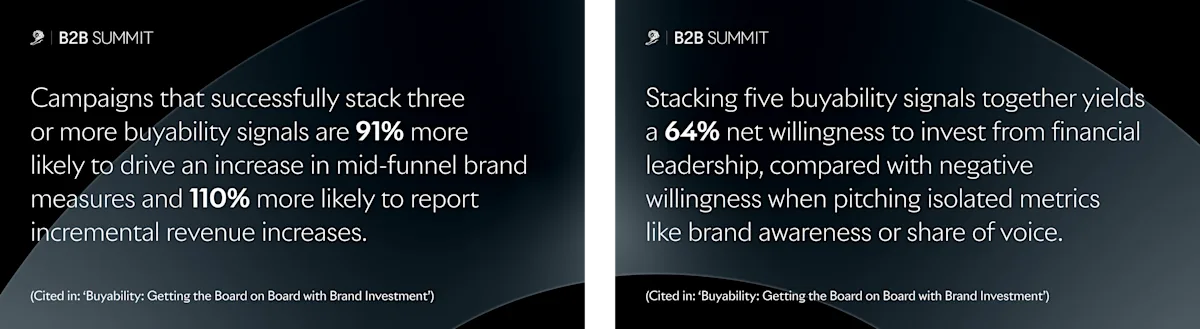
Highly creative campaigns deliver. Many speakers demonstrated that on our B2B Summit stage this year. We saw from LinkedIn and Bain’s new analysis of over 700 B2B campaigns that campaigns incorporating three or more “buyability signals” (being discoverable, being credible and defensible and being winnable) deliver massive commercial advantages. They are 63% more likely to report an improvement in ROI, and 110% more likely to drive incremental revenue increases.
Plus, while chief financial officers might glaze over at the mention of creativity or brand awareness in a speech from their CMO, pitching stacked buyability signals yields a 64% net willingness from financial leadership to fund the budget. This proves that creative boldness is the ultimate commercial lever.
We hope the insights and Lion-winning case studies from the 2026 Creative B2B Lions in this report leave you with actionable strategies to drive real growth. Thank you for helping us rewrite the playbook and bring unforgettable creativity to B2B.
Official LIONS B2B Summit Partner 2026

Jann Schwarz

Jann Schwarz
Senior Director, Thought Leadership
Mimi Turner

Mimi Turner
Head of Marketplace Innovation
B2B marketing does not have a value problem. It has a language problem.
We as marketers know that creativity drives growth, we can prove it, and some of us win Lions for it every June. The management thinker Peter Drucker knew it back in 1954.
Yet when we walk into a boardroom, we often cannot persuade the people who hold the budget money that brand is an investment rather than a line item to cut.
Closing that gap and “bringing the board on board” with B2B marketing investment was the job we set ourselves at this year’s LIONS B2B Summit. Our research shows that the C-suite will not fund brand. It will fund buyability. Same work, different language.
As this report lays out, buyability is a powerful concept because it aligns us closely with how buyers actually buy, and not how marketing departments are organised. As it turns out, that not only helps you persuade your CFO and your CEO, it also helps your creative to be much more effective.
So do one thing with this report. In your next budget meeting, or in your next creative review, retire the word ‘brand’ and walk in talking about buyability instead.
Buyability as the new commercial foundation
“Are you a safe choice?”
“The purpose of business is to create and keep a customer.” Jann Martin Schwarz reminded the B2B Summit audience of this famous quote by the late Peter Drucker in the LinkedIn keynote session ‘Buyability: Getting the Board Onboard with Brand Investment’. Schwarz, who is Senior Director, Thought Leadership, at LinkedIn, pointed out that there are only two things that achieve that aim: innovation (i.e. creating the product or service) and marketing (i.e. making people want the product or service). He urged the audience to use these facts to push back on anyone who describes marketing as a cost centre – and instead to tell the finance department that they are the cost centre.
Schwarz also used this to highlight the dangers of pursuing standard B2B marketing metrics, such as clicks, cost-per-lead and attribution models: “You know what is missing in all these metrics? The customer.”
Banning the attribution model from leadership meetings was an even more radical approach advocated by Colin Fleming, who leads B2B Marketing at OpenAI. Joining Schwarz on stage, Fleming agreed that his past teams had fallen into the trap of “marketing to the attribution model more than to the humans that buy our products”. By removing those limiting internal metrics, he was able to pivot the conversation to how brand investments directly correlate to the net new logo pipeline, a core principle of making a brand “buyable”.
What is buyability?
Buyability is a customer-centric B2B marketing framework focused on maximising a buyer group’s confidence to make a brand’s products or services safer and easier to choose. Moving away from internal, marketing-centric metrics like cost-per-click or marketing-sourced pipeline, buyability focuses entirely on the emotional and practical needs of the customer. It is built on three core pillars:
- Being discoverable so that buyers and AI tools can easily find the brand.
- Being credible so that buyers trust the brand enough to take a risk.
- Being winnable by providing proof that choosing the brand is a smart, defensible decision.
To operationalise this, marketers must embed specific “buyability signals” into their campaigns, such as peer recommendations, clear relationship working styles and relatability. Because B2B purchasing is a high-stakes group decision where buyers fear making career-damaging mistakes, buyability ensures that a brand feels like a safe, credible and highly defensible choice long before the buyer is even ready to make a purchase.
Discover discoverability
Being easily discoverable is no longer just about mastering traditional search engine optimisation – it’s a foundational pillar of making a B2B brand “buyable” in the age of artificial intelligence. As Schwarz points out, a brand must be “discoverable so that AI tools can find you” – because, ultimately, “if you’re not discoverable, you don’t exist, you’re definitely not going to win”.
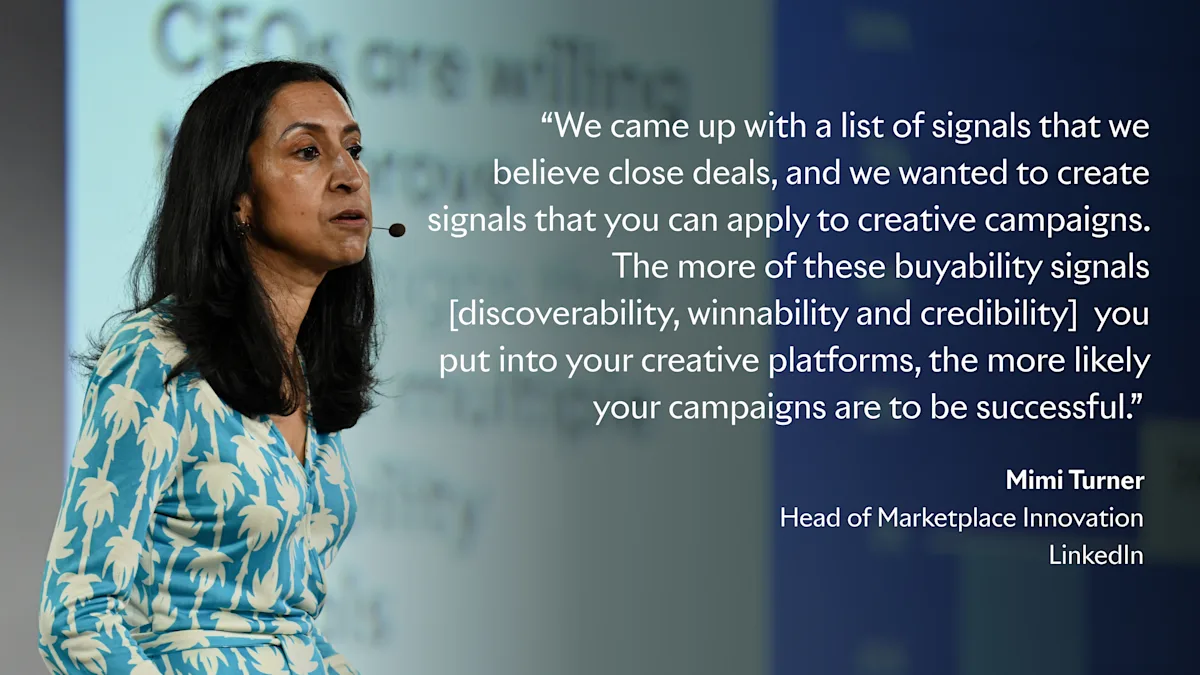
This reality is forcing marketers to rethink their top-of-funnel strategies. During a Cannes Lions session on ‘Cracking B2B Creativity: The Buyability Levers That Power Successful Campaigns’ on the Rotonde Stage, Mimi Turner, Head of Marketing Innovation at LinkedIn, said: “LLMs are now reshaping discovery and actually synthesising consideration lists.” This means legacy brands risk being left off the crucial “day-one list” if they’re not positioned as the exact right answer to a customer’s question.
Rachel Thornton, CMO of Adobe Enterprise, echoed this urgency, challenging B2B leaders to ask themselves not only how they’re “showing up at SEO”, but also how they’re “showing up in places like OpenAI”.
To achieve this new level of AI-driven visibility, B2B brands must look beyond the channels they directly control and lean heavily into community and employee advocacy. Thornton emphasised that conversations happening in the broader market, “whether it’s press or analysts, your customers, your community”, actively influence how discoverable a brand becomes to both buyers and AI models. This is where authentic human voices become a strategic advantage. As LinkedIn CMO Jessica Jensen highlighted, empowering employees to create a “surround sound of real contribution and insight is so key to buyability and discoverability”. In a landscape where “LLMs are at the forefront of discovery”, building this human trust and community presence is the engine that ultimately powers brand visibility.
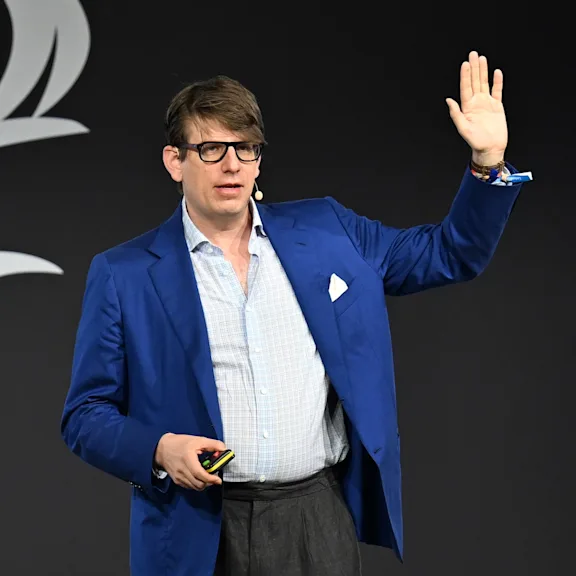
“If you’re not discoverable, you don’t exist and you’re definitely not going to win.”
Jann Martin Schwarz Senior Director, Thought Leadership, LinkedIn
Building credibility
Establishing a credible brand requires elevating it beyond a traditional marketing function so that it becomes a core driver of the business. Tom Stein, Chairman and Chief Brand Officer of Stein, pointed out in ‘Building Brand and Business Momentum Through Pure B2B Creativity’ how powerful this shift can be. He observed that it’s incredibly rare and impactful when a brand is “elevated to the role of strategic pillar in the...B2B corporate strategy” and described how real estate brand JLL had done just that with its 2030 Accelerate Corporate Strategy.
As the market has become flooded with AI-generated content, one agency executive creative director in the audience shared the modern challenge of “balancing creativity and credibility”. To cut through the noise and maintain authority, he argued that companies need “brand platforms and brand narratives that work much, much harder to differentiate and have a meaningful point of view”. His point was that brands need creative elements to put brand front and centre, just as JLL had done.
Beyond high-level narratives, a credible brand must back up its promises with tangible evidence and authentic voices. Ty Heath, Global Director of Thought Leadership GTM Strategy at LinkedIn and 2026 Creative B2B Lions Jury President, explained that true credibility is earned by proving you can actually help the buyer through real experiences. She said brands must operate on the principle that “you can show me more than you can tell me” – and talked about the importance of proving that you’re a trusted partner who’s there for the long-term journey through the things you show, say and do.
To amplify this trust on a human level, Monique Elliott, Chief Brand and Communications Officer at Schneider Electric, advised companies to actively build their reputation by finding the “credible voices” within their own ranks. Instead of just relying on the CEO, she suggested finding the internal experts “that your buyers already trust”. She said these are the people who know the customers’ exact problems inside out and hold “the most credibility with your ICP [ideal customer profile]”.
Working for the win
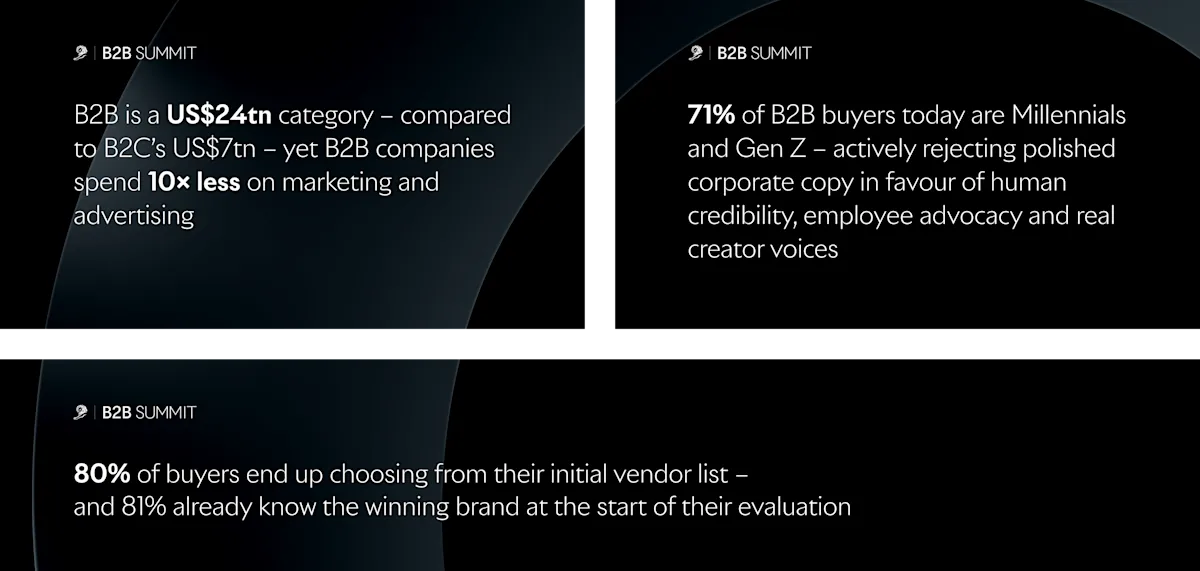
Being “winnable” is the final and crucial pillar of the buyability framework, focusing on giving B2B buyers the ultimate confidence to close a deal. As Schwarz explains, being winnable means providing the buying group with “proof that they’re going to do a good thing when they’re buying from you”. To actually win the deal, Rishi Dave, Partner at Bain & Company’s Commercial Excellence Practice, noted that marketers must first ensure they make a prospect's “day-one list”, because buyers end up choosing a vendor from that initial list 80% of the time.
Once a brand is on that shortlist, being winnable comes down to five critical perceptions from the buying group:
- whether the brand is a “safe choice” that won’t get them fired
- if the value is worth the cost
- how easy the brand is to work with
- how easy the solution is to implement
- whether it actually meets their needs.
By evaluating a brand against these five criteria across the entire buying group, marketers can establish a ‘likelihood to buy’ metric. Dave explains that this simple diagnostic acts much like a net promoter score, but it directly predicts a brand’s actual win rate in head-to-head competitions. Instead of relying on guesswork or purely internal metrics, analysing these winnability factors allows B2B leaders to “know the exact leverage to pull to increase win rate”. This proves that being winnable is not just a theoretical creative concept, but a highly measurable, operational strategy that systematically improves a brand’s ability to win competitive evaluations.
Need-to-know numbers
Examples from Lion winners
Heineken’s ‘The Pub that Refused to Die’, by LePub, Milan, demonstrates how embedding buyability signals transforms brand purpose into actionable buyer confidence. Heineken leveraged relatability by focusing on the real-world story of 26 locals in Kilteely, a small village in Ireland, and allowing other rural communities to see “people like us” solving a shared crisis: how to keep a rural pub open. Furthermore, by acting as a steward for the local hospitality ecosystem, Heineken signalled a collaborative relationship and strategic working style dedicated to keeping social life alive. Stacking these human signals – peer recommendations, deep relatability, tangible proof – elevated Heineken from a transactional beer supplier into a safe, defensible and deeply buyable brand partner. Among the campaign’s five wins were a Bronze in the Creative B2B Lions and the Creative Strategy Lions Grand Prix.
To make a brand truly “buyable”, marketers must win both emotional and intellectual arguments to convince a risk-averse buying group. ‘Reverse Media Schedule’ by Dentsu Creative, Auckland, for environmental charity Sea Cleaners and leading OOH advertiser JCDecaux, achieved this by reframing branded coastal litter not just as waste, but as unapproved, damaging media. Instead of relying solely on an emotional plea for corporate sustainability, the campaign used hard data to prove that branded litter actively reduces a customer’s purchase intent and lowers the price they’re willing to pay. This provided chief financial officers and business leaders with a powerful, rational financial reason to invest in cleanups. Ultimately, by paying to remove these negative brand assets from the streets, companies actively protected their credibility and brand value, which are core requirements for remaining a safe, defensible and buyable choice in the market. The work took a Silver in the Creative B2B Lions.
And Thai fertiliser producer Tra Mongkut’s ‘Soil Stay’ campaign transformed abstract data into powerful buyability signals of relatability and credibility. Realising that standard instructions wouldn’t change deeply ingrained farming habits, the brand invited farmers to stay at model farms and gain hands-on experience on soil identical to their own. This immersive approach provided a risk-averse farming community with the concrete proof they needed to confidently adopt new methods without fear of failure. Much like the JCDecaux/Sea Cleaners campaign, this helped Tra Mongkut become safe, highly defensible and buyable. By VML, Bangkok, the work won a Gold in the Creative B2B Lions.
Balancing AI with the value of the human signal
“Are you using AI to make your work better or to make more of it?”
Don’t remove the human head. That was the plea from Wendy Walker, CMO of trading platform Global Dairy Trade, in her session on ‘The Human Signal in an AI-driven B2B World’. Walker acknowledged that the introduction of generative AI into B2B marketing promises unprecedented speed, scale and productivity. But she warned that AI is fundamentally designed to generate what is average or likely, so relying on it without strong human direction risks flooding the market with homogenous “AI slop” and “noise” that is undifferentiated – a significant risk for brands. In an AI-driven world, the ultimate differentiator is the “human signal” – the trust, judgement, taste and conviction that sit behind the work. As B2B buying becomes increasingly mediated by machines and LLMs, this human substance is what makes a brand believable, memorable and safe to choose.
Walker shared the story of a talented junior member of her team who worked for her when she was CMO of Salesforce. That team member leant heavily on generative AI for copywriting as a source of reassurance, and Walker noticed a LinkedIn post created with the tool was polished but lacked the authentic brand voice because the AI had essentially "removed the human head”. She realised the solution was not to ban AI, but to reinsert human intervention at critical points to guide and refine the output. For B2B CMOs, the overarching learning is that fluency with AI tools is not the same as fluency in marketing craft – making it essential for leaders to protect the “human signal" and actively train junior marketers in developing true judgement.
The AI readiness gap
Walker referenced the lack of AI readiness among her peers. Noting her participation in a Chatham House Rule group of over 40 global CMOs, she highlighted that while this group 100% agree that AI is essential to the future of marketing, over two-thirds don’t believe their teams have the AI skills that they need.
According to Gartner research referenced by Walker in her talk, only 5% of marketers using generative AI solely as a tool actually saw any significant gains in business outcomes. This highlights a massive strategic readiness gap: AI tools often fail to drive impact because they’re bolted onto old systems without a clear strategy, turning into “productivity theatre” rather than true innovation. One VP of B2B for a marketing agency from the audience emphasised that AI must support a business imperative from a tooling perspective, rather than becoming “a means to an end”.
To successfully find a balance, B2B leaders need to embrace a simple truth: AI changes how marketers do their work, but it can never replace why they do it. Technology should handle the repetitive, rules-based chores that create friction in day-to-day operations. But CMOs and their marketing teams must fiercely protect the sacred creative spaces where meaning, trust and their brand’s hard-earned reputation are actually shaped. By handing the routine drudgery over to automation, they aren’t just cutting corners: CMOs are giving their marketing teams the breathing room they need to focus on their true strategic craft. Ultimately, gaining efficiency is only a win if brands actually use that newfound time to create real, human meaning.
Examples from Lion winners
In a category dominated by cold hardware specs and promises of automated efficiency, Claude’s ‘Keep Thinking’ campaign by Mother London reframed AI as an empowering “thinking partner” for human problem solvers. Declaring “there has never been a better time to have a problem”, Claude celebrated the authentic, messy process of human discovery. Shot on film with real scientists, hand-drawn typography and raw document textures, the campaign stood in stark contrast to standard tech advertising. This human-centric approach drove Anthropic’s business customer base from under 1000 to over 300,000 while boosting brand trust perceptions by 20.1 points. It was awarded a Silver in the Creative B2B Lions.
Claude’s work perfectly illustrates how human craft and conviction cut through category ‘AI slop’. Rather than positioning technology as a shortcut or human replacement, the brand used authentic human texture to build credibility and emotional resonance. It proves that protecting human taste and judgement is ultimately what makes an AI brand trusted, defensible and buyable.
And while competitors raced to sell automation and machine capabilities, software company ServiceNow’s in-house campaign ‘Put AI to Work for People’, shortlisted in the Creative B2B Lions, flipped the category narrative by championing the human beings technology serves. Borrowing B2C storytelling techniques, ServiceNow built a memorable cast of workplace characters, led by British actor Idris Elba, to mirror real enterprise buying groups. By deploying these characters across primetime sports, trusted news and digital retargeting, ServiceNow grew its unaided awareness from under 2% to over 22%.
Where competitors treated AI as a replacement tool, ServiceNow positioned AI strictly as an enabler while keeping human judgement, wit and emotion at the centre. By choosing human distinctiveness over generic category averages, ServiceNow demonstrated that human creativity, rather than raw machine output, is what raises the ceiling for B2B brand trust and long-term business growth.
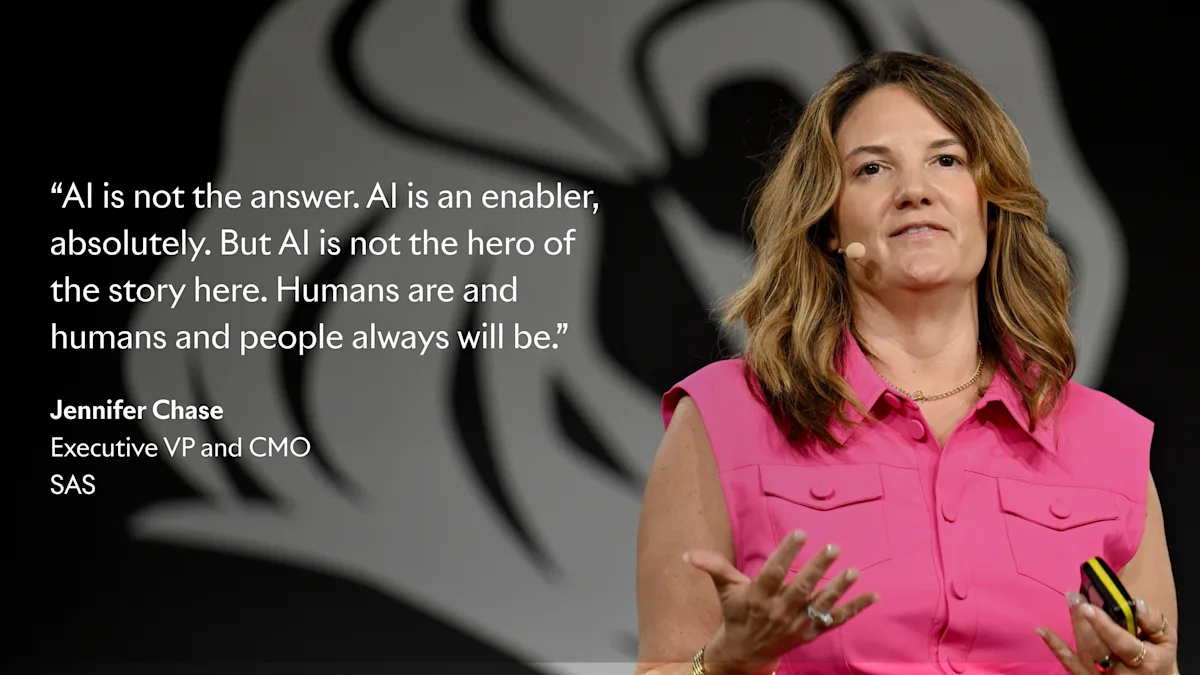
Brave is unforgettable: Creative premium in B2B
“B2B is boring. It’s our job to make sure our marketing is not.”
Road repair isn’t traditionally considered the most obvious entertaining premise to deliver a compelling story to hook in customers. But 2026 Creative B2B Lions Juror and alan.’s Managing Director Benedict Buckland shared the story of international road construction company Colas, which he described as a traditionally “unfashionable, unsexy” B2B organisation. The Icelandic arm of Colas faced a stagnant government that ignored traditional, stat-heavy PDFs and white papers regarding the country’s severe pothole problem. To disrupt this cycle, the brand took a creative leap of faith based on a bilingual pun: the Icelandic word for ‘pothole’ is hola, which sounds identical to the Spanish greeting for ‘hello’. Colas created a fictitious Spanish influencer, Nicolas, who was utterly obsessed with potholes, brought him to Iceland and filmed him travelling the country cheerfully documenting and greeting every hola he found.
Instead of pitching the government directly, ‘¡Hola!’ targeted the wider public first, knowing a democratic government ultimately moves for voters. Nicolas and his quirky pothole hunt captured the public’s imagination, creating a massive groundswell of community engagement that forced the fiscal authorities to act. Despite being an unsexy infrastructure brand, Colas functioned with the speed of performance marketing to create a highly entertaining, narrative-driven campaign: within six months of launch, the company won a €20m government contract to repair the potholes, followed by an additional €25m budget allocation for the next year.
This story illustrates a broader, highly profitable pattern across the B2B landscape: wildly creative storytelling consistently pays a heavy commercial premium.
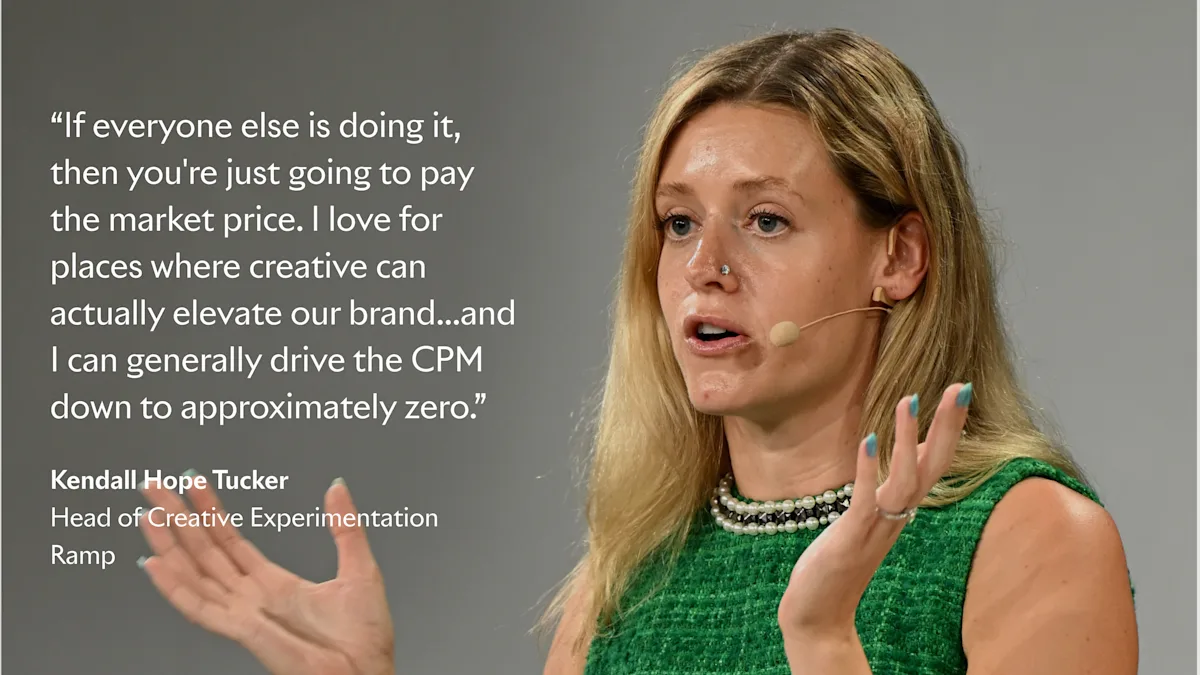
Kendall Hope Tucker, Head of Creative Experimentation at Ramp, proved this when she decided to showcase her company’s automated expense platform by building a physical glass box in Flatiron Plaza, a pedestrian-only public space in New York City, USA. She placed actor Brian Baumgartner – famous for playing Kevin, an accountant in US sitcom The Office – inside the box for eight hours, live-streaming him as he desperately tried to process receipts manually to ‘compete’ against Ramp’s AI. Baumgartner only processed 123 receipts, while Ramp’s system handled 600,000 – and the bizarre, highly shared stunt generated 214m organic views, a CPM near 0, and an astounding 4× return on ad spend (ROAS).
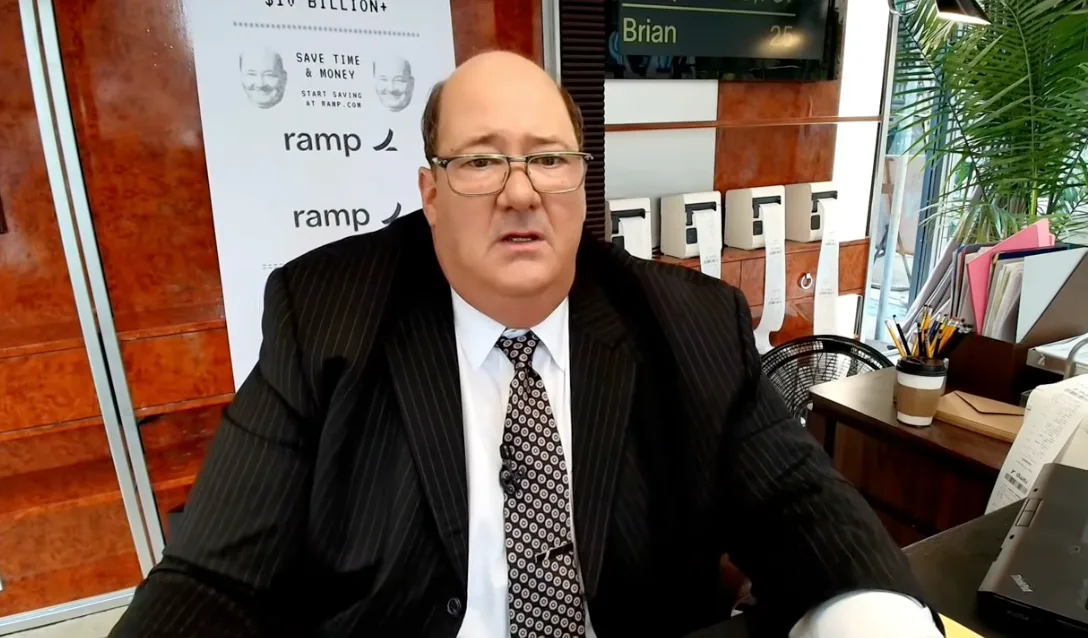
Actor Brian Baumgartner competes with Ramp’s AI tool in the ‘Brian Box Stunt’ (Source: Ramp’s YouTube channel, 15 October 2025 live stream titled ‘Brian's First Day As CFO - Live From NYC’)
Similarly, Global Dairy Trade CMO Wendy Walker pointed to an air compressor manufacturer in Japan, AIRMAN, which also completely lacked brand awareness. Rather than relying on traditional B2B celebrity endorsements or high-production product feature lists, the company cast its actual, real-life CEO as the star of a local, live-action superhero TV drama set in their hometown. The campaign became a viral sensation, dramatically boosting brand recognition and young talent recruitment, while also serving as a legendary icebreaker that systematically improved the brand’s sales efficiency during negotiations.
As these real-world campaigns prove, B2B marketing has never been inherently boring – it’s simply been under-loved and over-rationalised. B2B buyers are human beings who carry immense professional risk when selecting a vendor, meaning they naturally seek defensible, memorable trust signals. By elevating their creative ambition and using emotional, character-driven narratives, enterprise brands don’t just win attention: they systematically build the long-term credibility, category memory and board-level confidence required to close high-stakes deals.
In a modern attention economy where algorithmic feeds control what users see, B2B brands are no longer just competing with each other – they’re competing with consumer brands and pop culture. To achieve disproportionate returns, B2B marketers must be bold, entertaining and culturally relevant.
The division between B2B and B2C marketing has historically been defined by a severe budget and belief gap, but 2026’s top industry leaders are proving that bold creativity is a direct commercial lever. LinkedIn’s Mimi Turner points out that while B2B represents a massive US$24tn category compared to B2C’s US$7tn, B2B companies spend a staggering 10 times less on marketing and advertising. Turner warns that this “imagination gap, that creativity gap is the most expensive problem in marketing today”.
To bridge this gap, organisations must broaden their definition of who owns the creative spark. As Jennifer Chase, Executive VP and CMO at SAS, asserts: “Creative is not just the responsibility of your creative team. The idea of having much more enterprise creativity and commercial creativity, that has to be for everybody.”
For years, B2B leaders have struggled to justify brand investments to analytical boards because traditional metrics feel disconnected from actual customer acquisition. Resolving this tension requires connecting creative brand building directly to real pipeline growth.
Adobe’s Rachel Thornton has successfully unlocked boardroom funding by shifting the vocabulary away from vague “awareness” metrics. At Adobe, they reframe the conversation around “demand creation”. Thornton notes that when “you build demand creation up here, everything below it in mid-funnel, bottom funnel is much, much more efficient”.
When executing this creative vision, B2B brands must also resist the urge to produce dry, logic-only content. As alan.’s Managing Director Benedict Buckland said in the ‘Inside the Jury Room: Creative B2B Lions’ session, “B2B is only successful if you win both the intellectual and emotional argument”.
It was a point echoed by Phil Robinson in his session ‘From Macro to Micro: B2B Branding Outlook’. As Bloomberg Media’s Managing Director for EMEA, he shared exclusive Bloomberg research that emphasises that B2B marketers often forget that corporate decision-makers are, first and foremost, people who want human connection and emotional engagement. According to this research, 30% of B2B buyers actively seek an emotional narrative, while 39% want to see how a product or service personally impacts individuals.
However, Robinson warns that B2B brands cannot deploy emotion in a vacuum: if a campaign focuses solely on the human element without supporting data, it becomes “fluffy”, and if the emotion lacks data, it becomes “forgettable”. Ultimately, the most successful B2B storytelling must seamlessly weave together an emotional human narrative, hard facts and authentic credibility to showcase real stakes and real outcomes, giving buyers the professional confidence they need to justify their decisions.
Achieving this dual victory requires breaking category norms with bold, memorable experiences that command attention. For instance, one head of B2B marketing shared a perspective from the audience, describing how her team uses B2C-inspired, experiential activations, such as announcing a new enterprise product with a live stage rap or hosting synchronised swimming events, to build instant affinity. While these may seem untraditional for enterprise software, Robinson explains that “we invest in them because people have recall, they have talkability, they have memorability with our brand”.
Ultimately, embedding pure creativity into the core B2B strategy is no longer a luxury – it’s a baseline requirement for commercial survival. By choosing bravery over safe, invisible campaigns, B2B leaders can elevate their organisations from commoditised vendors into highly defensible, buyable market leaders.
Need-to-know numbers
Examples from Lion winners
We mentioned in the previous section road construction company Colas and its in-house ‘¡Hola!’ campaign, which disrupted the stagnant cycle of submitting stat-heavy white papers and waiting passively for government tenders that defined its category. The clever bilingual pun between the Icelandic word for ‘pothole’ (hola) and the Spanish word for ‘hello’ (also hola) was the insight that led to Nicolas, a fictitious Spanish influencer obsessed with finding potholes. This campaign proves that breaking category norms with bold, memorably storytelling allows B2B brands to bypass conventional noise, influence decision-makers and achieve extraordinary commercial returns.
But this wasn’t the only 2026 Lion-winning campaign to show this in action. This year’s Creative B2B Lions Grand Prix winner was ‘The Faroe Islands Space Program’ by Nord, Stockholm, for engineering company SKF, which transformed an unfashionable B2B component – industrial ball bearings – into a culturally resonant sustainability narrative. Facing soaring global energy demands and an industry increasingly looking to space for resources, SKF partnered with green energy company Minesto and Faroese power producer and distributer SEV to reframe tidal energy as “moon power”, launching a space programme that sent technology underwater rather than into the cosmos. By treating the project as a genuine engineering initiative, complete with custom spacesuits and underwater launches, SKF shifted its market perception from a commodity provider to a sustainable tech innovator. The campaign generated over 839m impressions, drove a 161% lift in sustainability perception and opened commercial pipeline across 16 new global markets.
This campaign proves that B2B marketing never has to be boring or confined to dry, functional spec sheets. Instead of isolating a commoditised component in a predictable product pitch, SKF did something entirely unexpected by anchoring its technology within a grand, imaginative narrative of lunar exploration. As the Cannes Lions Jury highlighted, B2B brands often languish in sameness when they view their products in a vacuum. SKF broke through by tapping into a much larger cultural conversation.
And to solve the luxury world’s rejection of lab-grown replicas, Lab-Grown Leather Ltd. (LGL) rejected the standard “sustainable substitute” pitch. Instead, it took a wildly creative leap of faith: resurrecting the skin of a T-Rex from 68-million-year-old fossil fragments to engineer the world’s most exclusive material. To achieve this, LGL’s creative ambition forced a technological breakthrough, co-authoring a brand-new AI method to reconstruct Cretaceous-era protein and cultivating it into a single, priceless handbag exhibited in a museum next to a dinosaur skeleton.
This act of ‘resurrection, not replication’ proved that pure B2B creativity is a massive commercial engine. The campaign turned a commoditised biomaterial into a global cultural event, driving a 279% surge in LGL’s share price, a 10× increase in inbound luxury brand interest and a 26% uplift in luxury prestige perception. Celebrating this intersection of storytelling, cutting-edge science and raw PR power, ‘T-Rex Leather’ won four Lions, including a Bronze in Creative B2B and a Gold in PR.
Don’t miss the chance to be where it all happens. Register your interest for Cannes Lions 2027 here.
If you would like access 2026 Festival talks from the LIONS B2B Summit and the rest of the Cannes Lions Festival, as well as all the winning and shortlisted work and more LIONS editorial content, subscribe to The Work here.
Other Cannes Lions 2026 reports
Cannes Lions Creativity Report 2026
The need-to-know trends, exclusive insights and biggest observations from the winning work.