The Official LIONS Sport Report 2026
Welcome to LIONS Sport: Where sport, creativity and innovation collide
Simon Cook

Simon Cook
CEO
LIONS
For years, sport has had a quiet but influential presence at Cannes Lions. This became official in 2019, when we launched the Entertainment Lions for Sport, which recognise the incredible work happening at the intersection of sports and entertainment. Year on year, we watched this space grow bigger, louder and more central to the broader global conversation surrounding creativity, culture and commerce. It became clear that sports marketing could no longer be treated as a side conversation or a seasonal activation. It was time to give it a permanent home.
The birth of LIONS Sport didn’t happen overnight. It’s the culmination of conversations with industry leaders, brands, leagues and rights holders – the very people who live and breathe this space every single day. What they told us was remarkably consistent: they wanted a dedicated, physical space at the Cannes Lions Festival where the brightest minds in our industry could gather to collaborate, challenge conventions and outline the future of this US$417bn sports landscape.
The inaugural LIONS Sport event and this accompanying report are built to celebrate that future. But as we step into this new era, we must also confront an uncomfortable truth: the old sports marketing playbook is officially obsolete. Sponsoring a team or an event by simply plastering a logo on a billboard, fence or jersey is now recognised as “spiritually invisible”. Armed with razor-sharp ad filters, modern fans detect and reject rented commercial intrusions and logo wallpaper. Today’s fans demand that brands move beyond that simple, passive visibility.
The future belongs to brands that entertain or educate fans, help them co-create their own experience of the sport or make their lives friction-free – so they can spend more time enjoying the sport. The most effective brand partnerships of tomorrow are those that use their unique capabilities to solve real economic, operational or emotional challenges for sports properties and their fan communities. We see this in IBM’s co-creation of an AI match summary tool for Wimbledon, which scaled digital editorial output by 300%, helping fans absorb the top shots from all the matches in the busy opening rounds. In Infosys’s haptic sensory board that allowed blind and visually impaired fans to track a tennis ball’s trajectory live in the stands for the first time at the Australian Open. And in Mastercard’s “just walk out” stores that eliminate agonising queue wait times at the AO sports precinct.
We observe it in the way athletics league ATHLOS has co-created its entire model with women athletes as active owners – re-engineering outdated and clumsy running bibs for women’s torsos, paying prizes via Cash App seconds after they cross the finish line and replacing traditional medals with custom Tiffany & Co. crowns to turn a track meet into an unmissable cultural party.
We witness it in the Kings League, which gamifies physical football with live power-up cards and halftime dice rolls, putting direct rule-making agency back into the hands of a hyper-engaged fanbase while eliminating dull scoreless draws. And we experience it in the fearless, unhinged storytelling of Riyadh Season’s boxing promos that bypass safe, sterile corporate clichés to turn elite heavyweight champions into cinematic characters packed with subcultural Easter eggs that show fans the brand truly speaks their language.
LIONS Sport is a celebration of these makers, thinkers and innovators, as well as the incredible athletes at the heart of the sports we all love. It’s a permanent foundation built to explore what each sport can teach other sports, elevate the thinking behind the work and deliver ideas that drive commercial and cultural impact.
Whether you’re a brand, a creative agency, a league or a rights holder, thank you for choosing to spend this time with us. We built LIONS Sport for you, and we can’t wait to see what you build next.
Become more than your logo
“Don’t ever do a logo placement. That’s plain and simple. Don’t do the logo placement.”
That was the recommendation of Celessa Baker, VP of Marketing Partnerships at Sephora, in her Creative Impact Unpacked session ‘Is Sport Incompatible with Marketing Effectiveness?’ on The Forum at Cannes Lions 2026.
Baker wasn’t alone in this view. In his LIONS Sport talk, ‘The AO Playbook: Stop Selling Sport. Start Building Culture’, Tennis Australia’s Director of Partnerships and International Business Roddy Campbell noted that sponsoring sports by simply plastering a logo on a billboard, fence or jersey is a lazy move that won’t get you noticed and talked about. Co-presenting with his colleague Britt Wickes, Head of Event Brand Marketing, Campbell said that traditional placements like a “logo slap on the fence” or a “lock-up in the press release” are technically visible but fail to connect because “we can see the brands are there but we don’t really know why they're there”.
But according to Tom Roach, VP of Brand Strategy at Jellyfish, as quoted by WARC’s Alex Brownsell in his session with Celessa Baker, “most practitioners still think of sponsorship as a bolt-on...a badge on a shirt, another line on a media plan”. Modern sports fans, who are equipped with acute ad filters, instantly detect and reject these shallow, rented commercial intrusions.
This rejection of superficial “wallpapering” is especially severe in high-growth spaces. Laura Correnti, Founder and CEO of Deep Blue Sports + Entertainment, warned that “women’s sports is definitely not a place you should come and think about badging it and calling it a day”, explaining that “wallpaper doesn't work here”. In her talk on ‘The Power of Sports as an Advertising Vehicle and Cultural Force’, she emphasised that brands need to build a community that the fans want to join and hang out in, rather than treating sports arenas as one giant billboard for hire: “It’s one thing to come in and buy impressions. This is a market where you need to make them.”
The same is true in the explosive world of esports, as Hero Esports Co-Founder and CEO Danny Tang noted in ‘Selling Out Olympic Stadiums – How Esports Rewrites Attention/Fandom. Tang observed that fans are highly sensitive to whether brands are “talking to them either from just a preaching perspective or just trying really trying to get to know them...and connect with them in a really genuine way”.
And at least some of the industry is responding to this trend by moving past traditional brand badging and towards functional integrations – using their brand’s unique capabilities to solve real economic, operational or emotional friction for the sports property and its fan community.
At the All England Tennis Club’s Wimbledon Championships, IBM did this by applying its generative AI and large language models to solve operational and accessibility issue for the tournament’s local and global audience. In ‘How AI Innovation is Serving Up the Future of Fandom, the brand’s VP of Sports and Entertainment Partnerships Kameryn Stanhouse shared that Wimbledon and the US Open tennis grand slams operate with a small foundational team of only five editors who physically could not cover all 254 simultaneous singles matches playing across 17 courts. IBM co-created an AI match summary tool that drafted structured post-match articles, keeping a human editor at the centre for accuracy. This scaled Wimbledon’s digital editorial output by 300%.
Educate fans to build deeper bonds
Traditionally, sports broadcasters have assumed that anyone tuning in would be familiar with all the relevant terminology – inadvertently excluding newcomers, casual viewers and global audiences from regions where the sport is unfamiliar or unplayed. But modern sports properties and technical partners are rewriting this discriminatory playbook by using tech to demystify complex sports rules, as well as track raw statistics and tell the stories of lesser-known athletes. And they’re fundamentally changing the fan experience as a result.
For example, IBM built ‘Match Chat’ to help casual fans and tennis novices feel included. This generative AI tool allows viewers to ask basic questions live – for example how to pronounce a player’s name or who has hit the most aces – so they can follow along without feeling out of the loop.
This type of educational empowerment can be a powerful entertainment vehicle. When fans understand the subtle ‘game within the game’, whether that’s a tactical momentum shift or a player’s serving pattern on a break point, they become deeply invested participants. As IBM’s VP of Sports and Entertainment Partnerships Kameryn Stanhouse put it: “Smarter businesses create smarter fans, and we’re in the business of smarter fans who foster connection.”
That’s not all, either. For the athletes on the field, performing in front of an intellectually engaged and data-fluent crowd is more fulfilling. Brands providing this intelligence can become established as indispensable guides rather than loud, distracting interrupters.
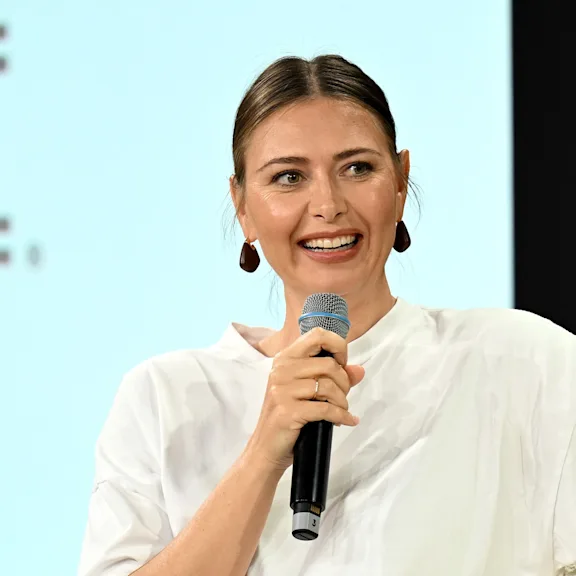
“The more informed a fan becomes, the better your experience is as an athlete because you know that everyone in the audience knows the game. They know the momentum swings, they know a person’s favourite shot...and that just makes you so into the game.”
Maria Sharapova Tennis Champion & Entrepreneur
Even when fans are well versed in a game’s rules and terminology, there’s room for brands to offer specialised knowledge. As NFL’s CMO Tim Ellis explained in the LIONS Sport ‘CMOs in the Spotlight session, research has shown that younger sports fans in particular “go deep into stats”. He advised: “If you give them something interesting, they’ll keep watching.”
And this openness can support players, too. For instance, Wimbledon and IBM re-engineered their digital Player Portal to give every qualifier the same access to premium tactical and performance data that, historically, only top-tier tennis players would’ve been privy to, as they’re the only ones who can afford to bring specialised data analysts onsite.
Solve real-world problems every day
When brands partner with a sport, their default instinct is often to focus on how the sport can serve their business. But the most culturally enduring and commercially successful sponsorships do the opposite: they focus on how they’re best placed to solve a real problem for the fans and their communities.
Modern sports fans don’t exist in a broadcast vacuum. They face agonising stadium queue bottlenecks or can’t get into playing a sport themselves because expensive athletic equipment or their own physical accessibility needs are barriers. They’re also people with full lives outside of being sports fans. And when a brand uses its operational, financial or technological power to support them, the brand transitions from a decorative corporate entity into a trusted community ally.
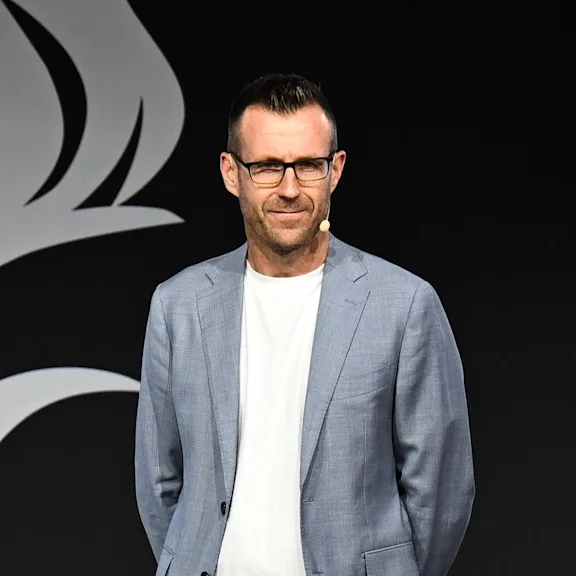
“The best deals are not decorative. They’re functional. They’re useful. They’re cultural.”
Roddy Campbell Director of Partnerships and International Business Tennis Australia
Founder and CEO of Deep Blue Sports + Entertainment Laura Correnti shared her perspective on creating physical services for parents and guardians such as childcare, nursing rooms or even parking space for pushchairs and prams – arguing that these are “the things that you need to not only cater to the athletes and their families, but your fans”.
Fans actively reward brands that respect their lifestyle, protect their play spaces and ease their everyday routines. When a shoe company designs high-performance gear for athletes with Down syndrome as adidas and its Toronto-based agency TBWA\Canada did with Innovation Lions Grand Prix and Silver Entertainment Lions for Sport winner ‘Supernova Adaptive’, or when a performance equipment brand tricks GPS algorithms to save streets for kids to play in as True Hockey did with Bronze Entertainment Lions for Sport winner ‘Game on Ball’, they’re not just running an ad. They’re demonstrating their product’s core purpose and usefulness under the ultimate test: real life.
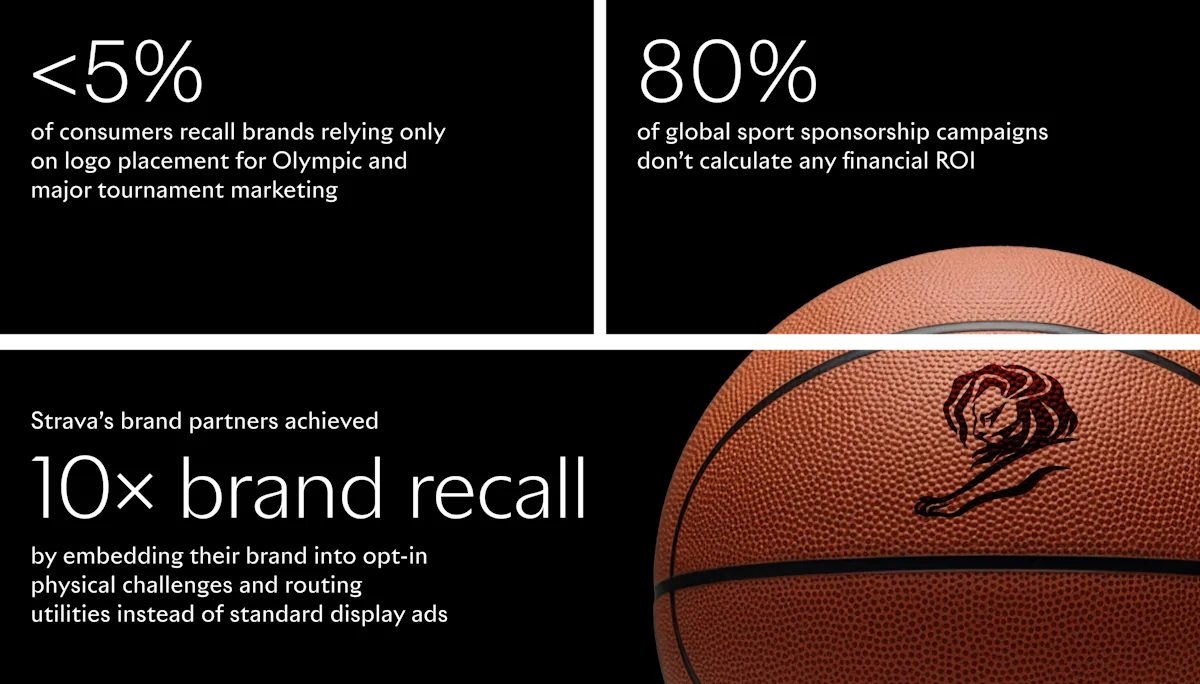
In the LIONS Sport ‘CMOs in the Spotlight session, Strava’s CMO Louisa Wee explained why brands must stop chasing broad, passive exposure and instead ask how their products can – in this case through AI – actively assist, inspire and support a consumer on their daily physical and wellness journeys. And in ‘The AO Playbook: Stop Selling Sport. Start Building Culture’, Tennis Australia’s Director of Partnerships and International Business Roddy Campbell gave a few examples of what that might look like – including one from payment giant Mastercard, a 2026 Creative Brand Lion winner, which eliminated long stadium queues at the Australian Open by powering ‘just walk out’ retail stores.
Examples from Lion winners
Facing relegation to the third division and a devastating loss of its main corporate sponsor, historic Peruvian football club Deportivo Municipal – or Muni – skipped traditional corporate sponsors and turned to its most passionate asset: its fans. With the help of McCann Lima, it redesigned the team’s jersey into a grid of 1000 sponsorship spaces and sold them directly to fans owning small businesses at prices ranging from US$30 to US$2000 – offering free custom logos and royalty-free rights to players for promotional campaigns in return. ‘The Thousand Sponsors of Muni’ reached 1000 businesses and helped the club secure the funds for its tournament entry fees. It won five Lions, including the 2026 Grand Prix for the Entertainment Lions for Sport.
THE THOUSAND SPONSORS OF MUNI | CLUB DEPORTIVO MUNICIPAL | MCCANN LIMA | GRAND PRIX, ENTERTAINMENT LIONS FOR SPORT | 2026
In Canada, navigation apps suggesting shortcuts through quiet, residential streets to drivers facing traffic bottlenecks on main roads placed the beloved sport of street hockey at risk of disappearing as kids no longer felt safe playing outside with cars racing through their neighbourhood. True Hockey and Dentsu Creative, Toronto, fought back by engineering ‘Game on Ball’ – a tech-enabled street hockey ball that emits a signal that tricks major navigation databases into detecting heavy congestion on the street where a game is active. The rerouting solution reached more than 2.6 million hockey fans and earned a Bronze in the Entertainment Lions for Sport.
adidas and TBWA\Canada, Toronto, discovered that traditional performance running shoes are unsuitable for people with Down syndrome, as they lead to issues such as poor balance, blistering, cramping and hypersensitivity. So they addressed this accessibility gap in the sports market by collaborating with runners who have Down syndrome to design a shoe that meets their needs – with features such as midfoot support, a custom gusseted tongue and a stable, adaptive heel. Sold in 29 countries, ‘Supernova Adaptive’ saw 42% of its US sales come from first-time buyers, proving that true sponsorship is built on authentic utility. It won four Lions, including the 2026 Innovation Lions Grand Prix and a Silver in the Entertainment Lions for Sport.
And Colombian beer brand Aguila made the national football jerseys – which normally cost the equivalent of 25% of the country’s minimum monthly wage – more financially accessible by offering fans a gamified trade-off: increase the size of the Aguila logo on the jersey and unlock discounts cutting down the price to as little as US$20. The jersey sold out in under two hours – a record for the brand. ‘Resize the Price’, by DAVID Bogotá, won a Gold in the Entertainment Lions for Sport, as well as two more Lions.
RESIZE THE PRICE | AGUILA | DAVID BOGOTÁ | GOLD, ENTERTAINMENT LIONS FOR SPORT | 2026
Build belonging and relevance
“Fandom is no longer just watching – people expect that you will listen to their passion.”
This is according to Elizabeth Lindsey, Global President of Brands and Properties at Los Angeles-based US sports, music and entertainment creative group THE·TEAM. Lindsey argued that contemporary fans expect active participation, real-time influence and collective community support. And she warned if a brand ignores this, the consequences can be severe: “Not only will they not spend with your brand, they will actually punitively take away spend from you.”
Lindsey wasn’t the only one to highlight this. In ‘Selling Out Olympic Stadiums – How Esports Rewrites Attention/Fandom, the University of Edinburgh’s Tongyu Liu, who specialises in esports psychology, argued that esports have changed the dynamic of the fan–athlete relationship, with sports stars like F1 driver Lando Norris or NFL player Travis Kelce connecting with fans by posting content and building their social media presence. According to Liu, this unprecedented access to previously “unreachable” athletes has cultivated a “transparasocial” connection between fans and sports professionals. She suggested that the esports category, where streaming was built into the experience from the outset, has a lot to teach traditional sports brands on how to build fandom and connect with athletes.
Formula 1 driver George Russell also argued in favour of shifting towards raw, human-centric storytelling. In his session on ‘What Pressure Reveals: The Edge between Good and Great with Marriott International President and CEO Anthony Capuano, Russell contended that documentaries like Netflix’s Formula 1: Drive to Survive have transformed fan connection by showing audiences that racing is a deeply collaborative ‘team sport’ rather than a solo endeavour. He argued that entertaining modern fans requires stripping away the safe, corporate façade of athletes to reveal the intense psychological realities of competition. For Russell, this means being open about the arduous “emotional hangovers” of both victory and defeat, embracing failures as necessary stepping stones to personal strength and reminding the public that athletes are teammates who navigate the same raw, vulnerable human experiences as the fans cheering in the stands.
Need-to-know numbers
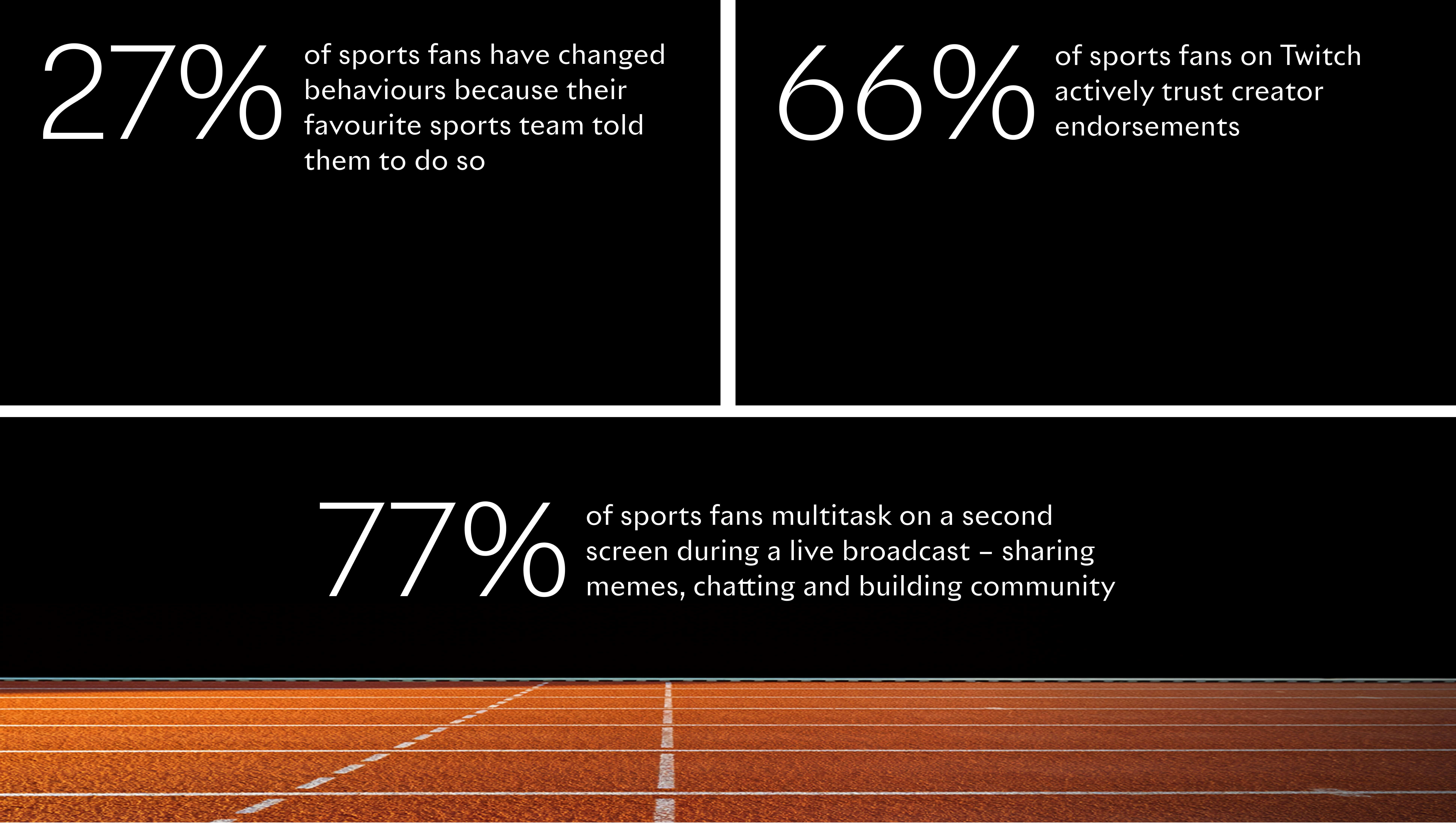
Examples from Lion winners
Polish football club Wisła Kraków took a database mandated by Polish law to track stadium entrants, cross-referenced it with years of post-match statistics and built a personalised ‘Lucky Fan Index’ for each of its supporters to see how much ‘luck’ their physical presence brought to the team. It also rewarded the luckiest fans with VIP box upgrades and the unluckiest with steep merch discounts to buy “luckier” gear. By leveraging the universal phenomenon of football superstitions and giving fans data-driven agency over them, Wisła Kraków FC increased average stadium attendance by 42%, achieving the highest attendance in the entire league despite having been relegated from the top division. The work, by VML, Warsaw, took home six Lions, including the Creative Commerce Lions 2026 Grand Prix and a Gold in the Entertainment Lions for Sport.
LUCKY FAN INDEX | WISŁA KRAKÓW FOOTBALL CLUB | VML, WARSAW | GOLD, ENTERTAINMENT LIONS FOR SPORT | 2026
Another superstition-themed Entertainment Lions for Sport winner came from craft brewer Mikkeller in Taiwan, where baseball fans refuse to watch games live during high-stakes tournaments like the World Baseball Classic (WBC) for fear of ‘jinxing’ their team. To solve this psychological friction, Mikkeller broadcast the classic Taiwanese period TV drama The Pioneers in its bars during game time. Except, thanks to voice cloning and lip synching technology, the cast were no longer acting out their scenes: instead, they were providing a real-time audio commentary of the live game. ‘The Switch Hit’, by Ogilvy Taipei, allowed fans to follow the game ‘jinx-free’ while enjoying their beer – and perhaps even played a role in Taiwan defeating Korea for the first time in history.
And Gatorade helped lower the high dropout rate of El Cruce, one of Latin America’s most gruelling three-day trail running events, by embedding its branding directly into the physical struggle of the race. Together with Tombras, Buenos Aires, it designed a modular ‘Fragmental Medal’ that was awarded to runners fragment by fragment after completing different milestones, at the point where most would quit the course. By turning its branding into a physical motivational tool, Gatorade helped decrease the dropout rate by 80% and was awarded a Bronze in the Entertainment Lions for Sport.
Make the entertainment leap
“We needed to stop competing in our category. We stopped acting like a sport and started acting like a summer entertainment proposition.”
This was the stimulus behind the radical reinvention of cricket’s rules by Rob Johnson, Managing Director of Audiences at the England and Wales Cricket Board (ECB), who spoke with Adam Bullock, Co-Founder of The Multiple Agency, on how they turned The Hundred from a professional league to a live cultural event in ‘Breaking Boundaries – 100 Balls, 1 Billion Dollars’.
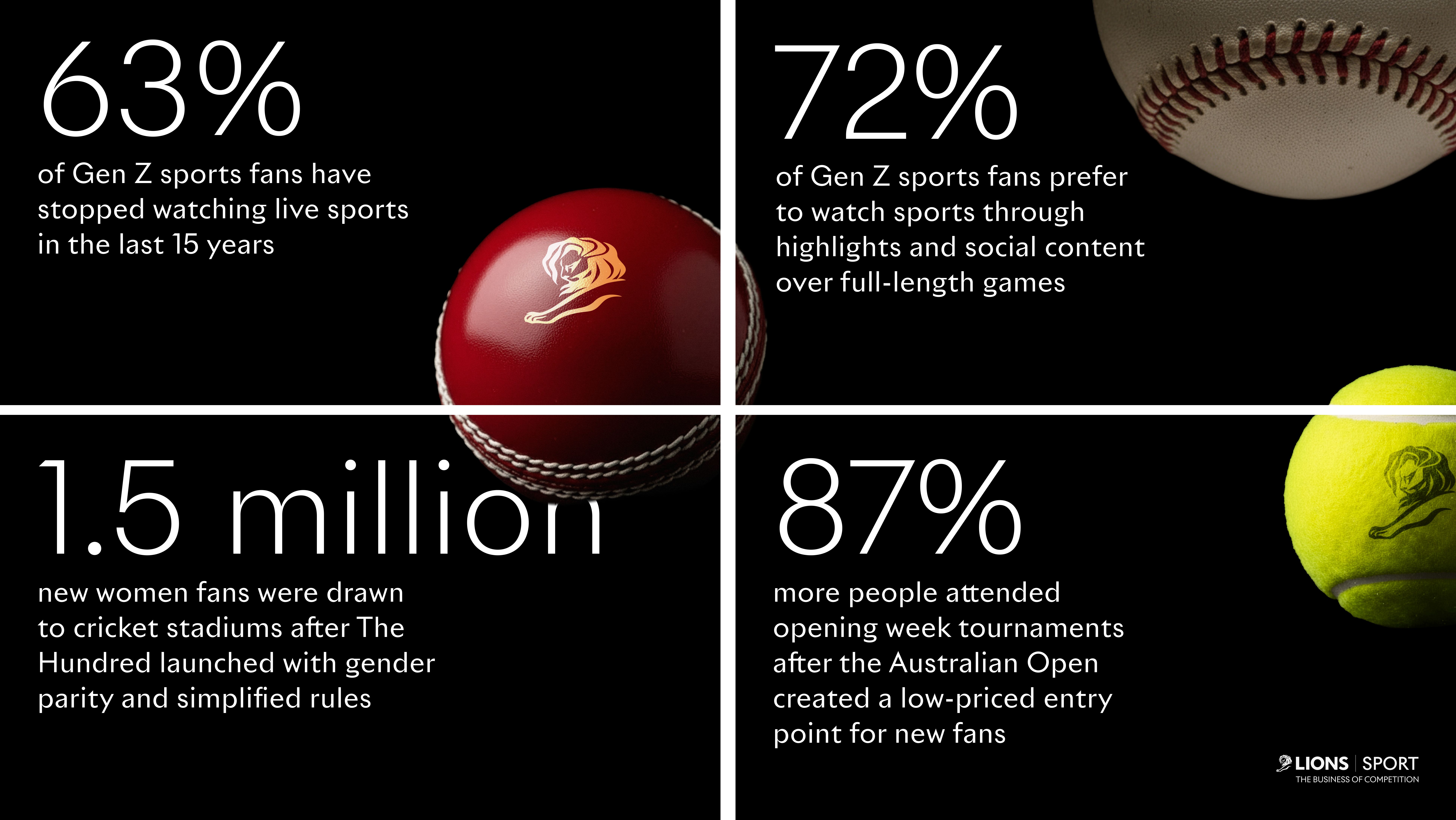
Faced with an ageing fan base and a sport perceived as too slow, too exclusive and too complicated, the ECB partnered with British broadcasters Sky and the BBC to capture a new generation of fans by embracing “radical simplicity”. They threw out the dense rulebooks, simplified the scoreboards to track only two numbers and put the men’s and women’s teams on equal footing, sharing the same stadiums, marketing budgets and travel accommodations. They also integrated live pyrotechnics, sonic branding and live music stages featuring artists like Zara Larsson and Jax Jones. This festival-style makeover solidified the league’s status as a “summer entertainment proposition” – and drew 1.5 million new women fans, building a lucrative, modern commercial asset.
The Hundred’s evolution is part of a wider trend of traditional properties making high-stakes bets to appeal to modern audiences and reverse the decline in traditional live viewership among Gen Z. By prioritising accessibility, spectacle and fan agency, these leagues are capturing a huge, untapped demographic of audiences who previously had no interest in the game. As Twitch’s Chief Product Officer Mike Minton put it in his session on how Gen Z is engaging with sport, the athletic competition is no longer the sole event in this re-engineered ecosystem – it’s the anchor for a broader cultural celebration.
Another example of this is the Australian Open, which managed to attract new Gen Z fans by adopting the live entertainment approach. Tennis Australia’s Head of Event Brand Marketing Britt Wickes shared the four strategies that have created new entry points for prospective fans, ranging from festival music on tournament grounds and dedicated spaces built for and by Gen Z to the One Point Slam, an entry-level tournament pitting some of the world’s biggest tennis players against amateurs.
ATHLOS has taken a similar approach. Olympic Gold medallist and long jump world champion Tara Woodhall-Davis, who’s the headlining field event athlete for the meeting series, explained how it’s spearheading a track and field revolution in a session on ‘Game Changers: How Emerging Sports Leagues Are Redefining Fandom. By moving field events out of traditional arenas and directly into the streets of Times Square, in New York, USA, ATHLOS has created a packed, high-energy “party” where women athletes are positioned as the central storytellers and empowered to compete freely.
Even the most traditional sports are evolving. In the same session, film producer Oriol Querol talked about the Kings League, which he created together with former Barcelona star Gerard Piqué to eliminate the possibility of a boring match and appeal to “fans raised on streaming, memes and the chaos of the internet”. He shared how the Kings League – where he serves as Chief Product Officer – has gamified physical football by introducing video-game-style elements like half-time dice rolls and randomised secret “power-up” cards that could activate perks like instant penalty kicks, double-goal-value windows and benching of opposing players. It has also transformed traditional sport into an interactive, unscripted live stream by handing over club ownership to the world’s largest creators and streaming matches for free across Twitch, YouTube and TikTok.
This philosophy of dismantling traditional, slow-paced sports formats to thrive in the creator economy is transforming other heritages sports, too – like golf. In ‘Marketing in the New Era of Sports, 2× US Open Winner and content creator Bryson DeChambeau admitted that, in its traditional four-hour linear broadcast format, watching professional golf can sometimes feel like “watching paint dry”. Rather than relying on traditional sports television to build his brand, DeChambeau built an in-house creative team with backgrounds rooted in fast-paced video games and began compressing tournament rounds into hyper-dynamic one-hour YouTube spectacles. This allowed him to convert a historically exclusive, slow game into an addictive pop-culture proposition – as well as speak to his new audience of more than 3 million subscribers with unfiltered candour.
Need-to-know numbers
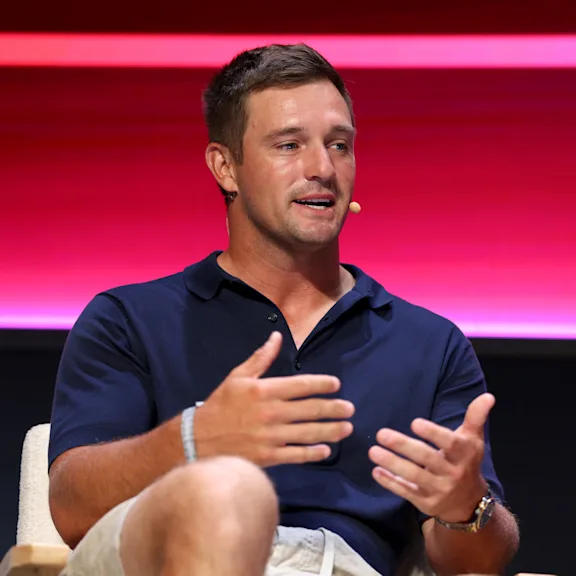
“They were able to pull together something that made [golf] feel more fast-paced and easier to digest. […] Four hours to one hour, that was our goal and we did that – and it’s grown golf in a cool, unique way.”
Bryson DeChambeau Professional Golfer 2× US Open Winner
Examples from Lion winners
In Winnipeg, Canada, fast-food chain KFC threw out safe corporate guidelines and leant into local fan banter after passionate ice hockey fans went viral with a tongue-in-cheek stadium chant for star player Kyle Connor: ‘Kyle F* cking Connor’. It rebranded its Winnipeg restaurant, sent a life-sized Colonel Sanders to the game dressed in ‘whiteout’ fan gear and distributed custom branded buckets for fans to wear on their heads. The viral local campaign by Courage, Toronto, led to a growth of 22% in sales in store and 358% in brand affinity. It took home four Lions, including a Gold in Brand Experience & Activation and a Silver in the Entertainment Lions for Sport.
KYLE F*CKING CONNOR | KFC | COURAGE, TORONTO | SILVER, ENTERTAINMENT LIONS FOR SPORT | 2026
Latin America’s largest e-commerce platform and leading football sponsor, Mercado Libre, transformed the vocal energy of fan chants into active commerce through ‘Discount Chants’. This interactive platform synchronised stadium billboards with football crowds, unlocking real-time discount coupons on the Mercado Libre mobile app for products ranging from beers to TVs as soon as fans chanted a song referencing them. Converting a passive stadium advertisement into a gamified tool of direct fan participation, the campaign by GUT Buenos Aires saw a 139% jump in coupon use. It was awarded a Bronze in the Entertainment Lions for Sport, as well as a Silver Lion in Outdoor and in Direct.
And when NFL superstar Travis Hunter received a record-breaking deal for his two-way skills in offence and defence, video game Clash of Clans capitalised on the moment by challenging fans to play ‘two ways’ like Travis for the chance to win millions of in-game currency. Mirroring NFL draft tactics, the brand analysed the real-time gameplay of ordinary players to calculate their defensive skills, offensive power and win–loss ratios. ‘Two-Way Deal’ attracted more than 1 million new players, proving that a fan’s digital effort is as watchable and prestigious as a pro athlete’s physical triumphs. By DAVID New York, it took a Bronze in the Entertainment Lions for Sport.
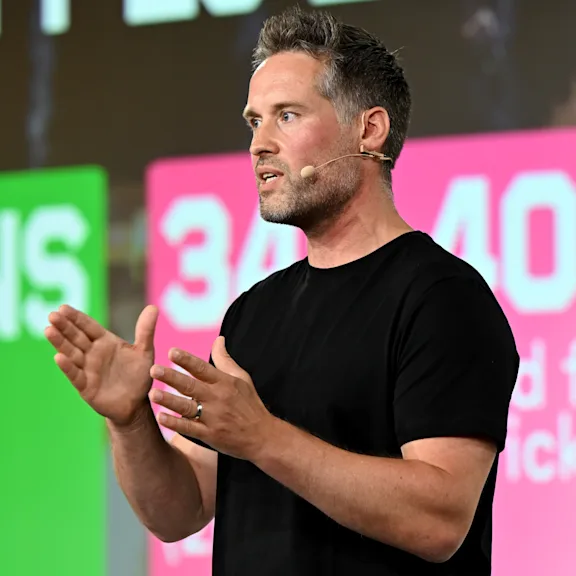
“Disruption isn’t the risk. Standing still is the risk.”
Rob Johnson Managing Director of Audiences England and Wales Cricket Board
Fight for more than just a sporting victory
“I don’t think sport has an obligation to make change. We, as decision-makers, have an obligation to make change.”
This was the view of Nick Keller, Exec Chair of Think Beyond and Beyond Sport, speaking in ‘Sport at a Crossroads: Growth, Relevance and Human Value. Keller argued that it’s “our obligation as human beings living in the time that we are” to push for growth, highlighting the power of sport to "fundamentally change individual lives”.
This isn’t new, of course: sports stars have long fought for more than just victory on the court or pitch. The late tennis star Arthur Ashe, the first-ever Black man to be selected for the US Davis Cup team in 1963, famously used his status as an elite player to speak out against racial inequality. Billie Jean King, the first woman athlete to be named Sports Illustrated Sportsperson of the Year in 1972, has done the same in support of LGBTQ+ and women’s rights. More recently, NFL star Colin Kaepernick took the knee instead of standing during the pre-game anthem in 2016 – a move that was adopted across the globe by sports stars in the wake of the Black Lives Matter movement. And on the podium at the 2020 Tuscan Grand Prix, F1 seven-time champion Lewis Hamilton wore a shirt demanding justice for Breonna Taylor, the African American medical worker who was killed by police officers in her own home.
As traditional institutions experience unprecedented public criticism, sports have emerged as a cultural anchor – the last true global moment that draws simultaneous mass attention and brings deeply divided communities together. Being visible falls short. Brands must capture the heart – as well as the eyeballs – of their audiences.
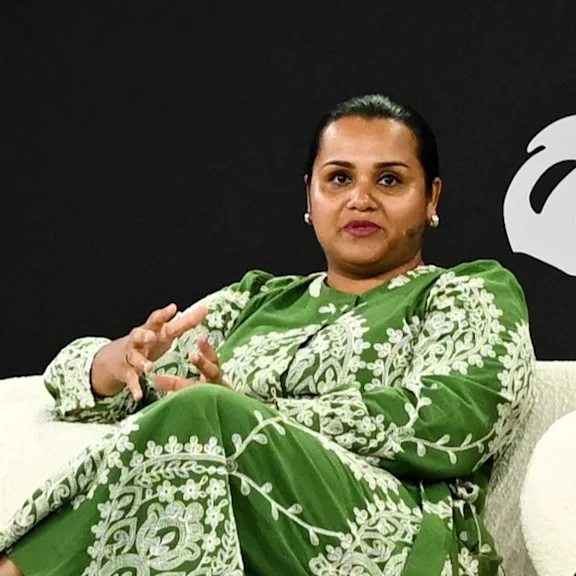
“What does it mean for us to change the way we operate, our internal systems and structures – to collaborate at a transformational level where all of us contribute towards a common goal? I would call it radical collaboration.”
Jayathma Wickramanayake Policy Advisor, Sport Partnerships UN Women
As NFL’s CMO Tim Ellis explained in the LIONS Sport ‘CMOs in the Spotlight session, brands must “stop using sport just as an association of value” and instead find ways to “connect with people on a human emotional level and talk about things that maybe might even make you a little uncomfortable”.
This means using a brand’s unique capabilities, operational scale and media assets to stand as a protective shield and advocate for fans. Modern fans don’t leave their real-world struggles at the stadium gates. They face systemic gender inequality on the sidelines, alarming rates of hate speech and racism in the stands and severe human rights violations in their daily lives. Brands that break down these barriers can transition from a passive corporate sponsor using media placement into an active community ally.
Equal pay and gender justice
For decades, the sports industry treated investment in women’s athletics as a charitable afterthought or a safe ‘goodwill’ checkbox. But that era of passive, superficial corporate handouts is over, and a new level of fan-driven accountability is reshaping the market.
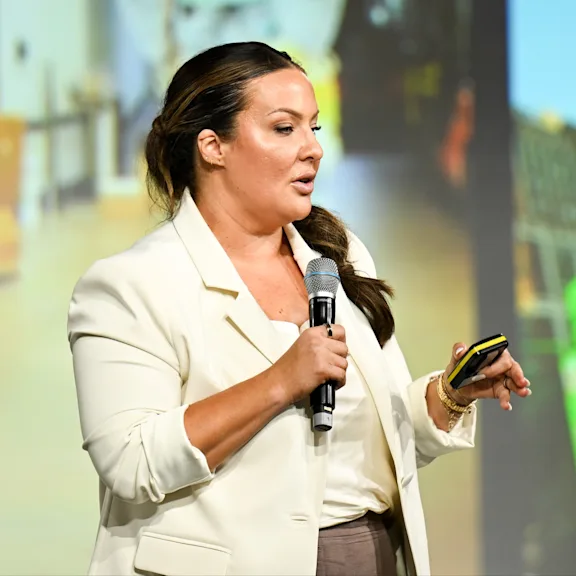
“Women’s sports fans have had to carry this industry on their backs since its inception. Now that commercial investment is coming into the space, there’s a level of accountability that these fans are driving for it.”
Laura Correnti Founder and CEO Deep Blue Sports + Entertainment
Deep Blue Sports + Entertainment CEO Laura Correnti highlights this shift by pointing to the historic 2019 moment when the US women’s national soccer team won their fourth World Cup title in France while suing their own federation for equal pay. Instead of a standard patriotic celebration, the stadium erupted into a unified chant of “equal pay”. This wasn’t just a sporting victory – it was a watershed moment that turned a live sporting arena into an active, unmissable platform for sociopolitical progress.
A LIONS Sport panel on ‘Rethinking How We Keep Girls in Sport urged brands to sustain this momentum by addressing the broken underlying systems instead of hiding behind short-term campaigns. They warned that a pipeline crisis looms over the industry, as young girls are pushed out of play at twice the rate of boys by age 14 due to negative social norms, safety concerns and a lack of local infrastructure. Standard Chartered Group Chief Operating Officer Tanuj Kapilashrami and F1 Academy Managing Director Susie Wolff argued that sponsorships must be integrated into core business strategy to build permanent, profitable models of ROI. According to Lisa O’Keefe, Secretary General of the International Working Group on Women and Sport, true progress requires transforming internal corporate structures and putting the cash on the table to redesign the physical and financial system from the ground up.
Need-to-know numbers
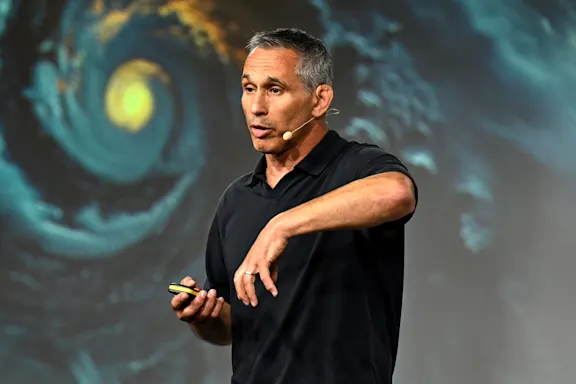
“Our minds are made up of ideologies and stories that divide and polarise us. But our DNA is 99.9% the same. And with sport, we get to use our body, mind and emotions at the same time in real time.”
Nick Keller Exec Chair Think Beyond / Beyond Sport
Examples from Lion winners
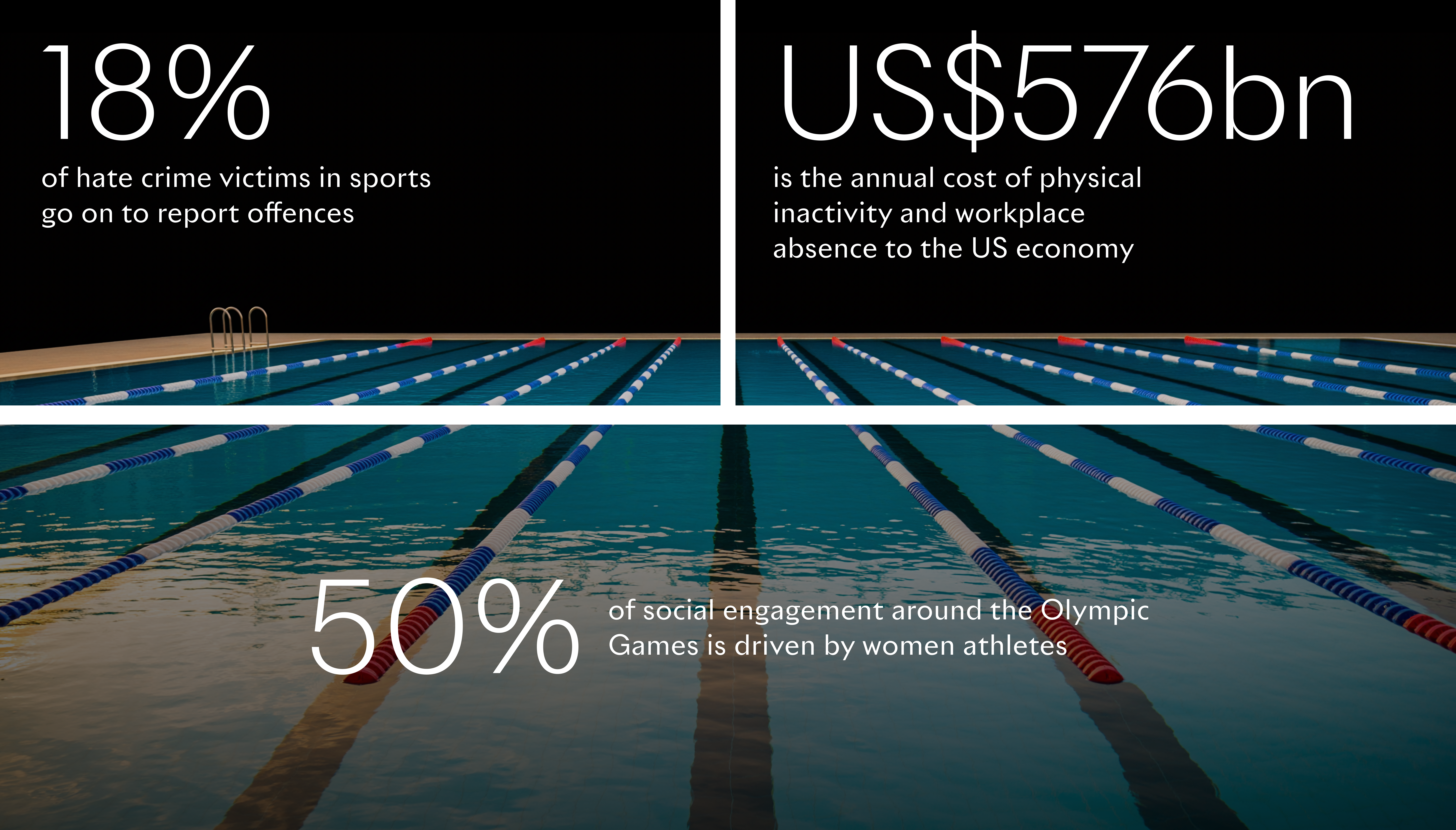
In Brazil, racist abuse online has grown by over 40% in a year – yet only 18% of these hate crimes are reported, mainly due to the complexity of the filing process and lack of legal knowledge. To dismantle this systemic friction, Misterio Publico do Distrito Federal and Ogilvy Health, New York, co-created ‘Fair Play’, an AI model trained on international criminal law and ethical frameworks to identify hate speech and allow victims to file legally verified complaints 97% faster. The tool reached more than 260,000 users in its first month alone – and was endorsed by top Brazilian club Atlético Mineiro. It won two Lions: a Silver in Health & Wellness and a Bronze in the Entertainment Lions for Sport.
In the UK, Xbox and Sky Sport turned a gaming pastime into a career gateway through ‘Missing Managers’, an initiative inviting women gamers who completed a unique in-game challenge to apply for real-world managerial training. Designed to plug the significant gender gap in football managers, the bespoke five-year programme involves hands-on work placements at top professional clubs and official UEFA qualifications. This strategic collaboration was a commercial success, driving a 41% increase in Football Manager sales – and it led to societal change, too, with FIFA passing a landmark rule that women’s teams must have a woman head coach or assistant manager four months post-campaign launch. By McCann London, it won two Lions, including a Bronze in the Entertainment Lions for Sport.
MISSING MANAGERS | XBOX | MCCANN LONDON | BRONZE, ENTERTAINMENT LIONS FOR SPORT | 2026
And when French sports journalist Christophe Glaise was sentenced to seven years in an Algerian prison, Reporters Without Borders and The Good Company, Paris, hacked the live commentary of a football match to deliver a psychological lifeline. As Glaise’s only link to the outside world was a TV in his cell, where he watched Paris Saint-Germain matches, they arranged for his mother to take over the mic in the broadcast booth for 30 seconds and deliver a personal, uncensored message of love, hope and legal updates to him. ‘A Mother’s Commentary’ led to 33,000 petition signatures – 65% above target. It won three Lions, including a Silver in the Entertainment Lions for Sport.
Turn the athlete and creator into the media channel
“Athletes are now creators themselves, and that opens up all kinds of opportunities.”
This is according to Tim Ellis, CMO of NFL, who spoke on a special LIONS Sport edition of the Cannes Lions ‘CMOs in the Spotlight’ series. He said that athletes are now becoming “much more empowered” and “a part of the process” – a tremendous shift from their traditional billing as elite human beings who are as unapproachable as they are undefeated.
The domination of digital platforms and creator networks has enabled – and deepened – the connection between athlete and fan. It’s also set up sports stars to reclaim their own stories as complete human beings, not just competitors. Focusing on that athlete as an individual – and as a creator in their own right – is the most direct and credible way to build lasting fan relationships.
Normalise the human under the helmet
Formula 1 is often romanticised as engineering precision meeting human expertise. Yet during the panel on ‘What Pressure Reveals: The Edge between Good and Great,’ Mercedes-AMG driver George Russell delivered a poignant truth about elite performance. He acknowledged that beneath the helmets, fire suits and multimillion-dollar sponsorships, athletes are going through psychological challenges just like the audiences watching them from the grandstands. “We sometimes forget that, ultimately, we are all just human,” Russell reflected, calling for a deeper culture of mutual care within sports and business alike. “Every single one of us is moving through life balancing our own private struggles with our own celebrated successes. It doesn’t matter if you have reached the absolute summit of your industry or if you are just starting out on day one. We have a quiet obligation to check in on one another. At the end of the day, we are all teammates.”
Brands that can build partnerships that reference and support athletes’ real-world routines and challenges appear much more authentic to fans experiencing similar issues. It also gives athletes an opportunity to think of themselves as a media house first and competitor second. They can put out a lot of fast-paced and unfiltered content across platforms such as YouTube and Twitch, reaching millions of fans and bypassing the traditional media that might control or manipulate their messages.
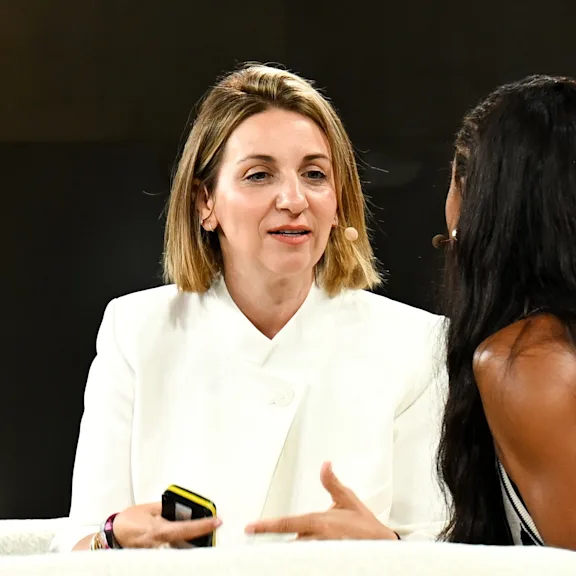
“Athletes are your media channel. Once you centre the athlete, the athlete will tell everybody about it.”
Kayla Green Acting President ATHLOS
Turn athletes into characters
Sports marketing commands some of the largest budgets in global advertising – yet it produces some of the safest, most predictable advertising and marketing. Athletes’ agents can often book them into short slots for shoots and will talk athletes out of anything that feels “off brand”. Any lines or wardrobe choices that feel too funny, too risky or too much like a gimmick can be vetoed. This can lead to work that feels very homogeneous – and dull.
Mohammed Sehly, the Emmy-winning CEO of BigTime Creative Shop, believes that this safe approach is a commercial disaster because “fans have no mercy for bad or mediocre work”. If a brand’s creative is invisible or predictable, e.g. ‘face-off’ visuals for boxers, it’ll be met with empty and silent YouTube comment sections – the ultimate sign of failure, according to Sehly, who says that agencies must have the courage to protect the core creative idea at all costs. They should also act as if they’re shooting a film, using storytelling and making elite athletes the protagonists.
Riyadh Season’s viral, multi-Lion-winning ‘Obsession’ campaign, for example, replaced the standard press stare-down with a film shot by Guy Ritchie. The British director cast heavyweight champions Tyson Fury and Oleksandr Usyk into highly crafted, obsessive characters acting out fever dreams, with Usyk ‘doppelgänging’ Fury’s wife to get inside his opponent’s head. The promo went even more unhinged by casting Matchroom Sport Chairman Eddie Hearn as a zombie flicking cigar ash into another zombie’s head. This character-first format generated 4.2bn impressions and led to Usyk receiving mainstream feature film offers.
Sehly urged creatives to use Easter eggs, i.e. little nods to the stories behind the sport, calling them “the most common language between you and the fans”. He offered a number of examples of this, such as an “ostarine-free burger” mocking boxing star Ryan Garcia’s performance-enhancing drugs scandal, a graffiti-tagged statue representing Dmitry Bivol’s controversial 2025 win against Artur Beterbiev or a nod to the iconic “peeking” diving pose of ex-footballer Sergio Busquets.
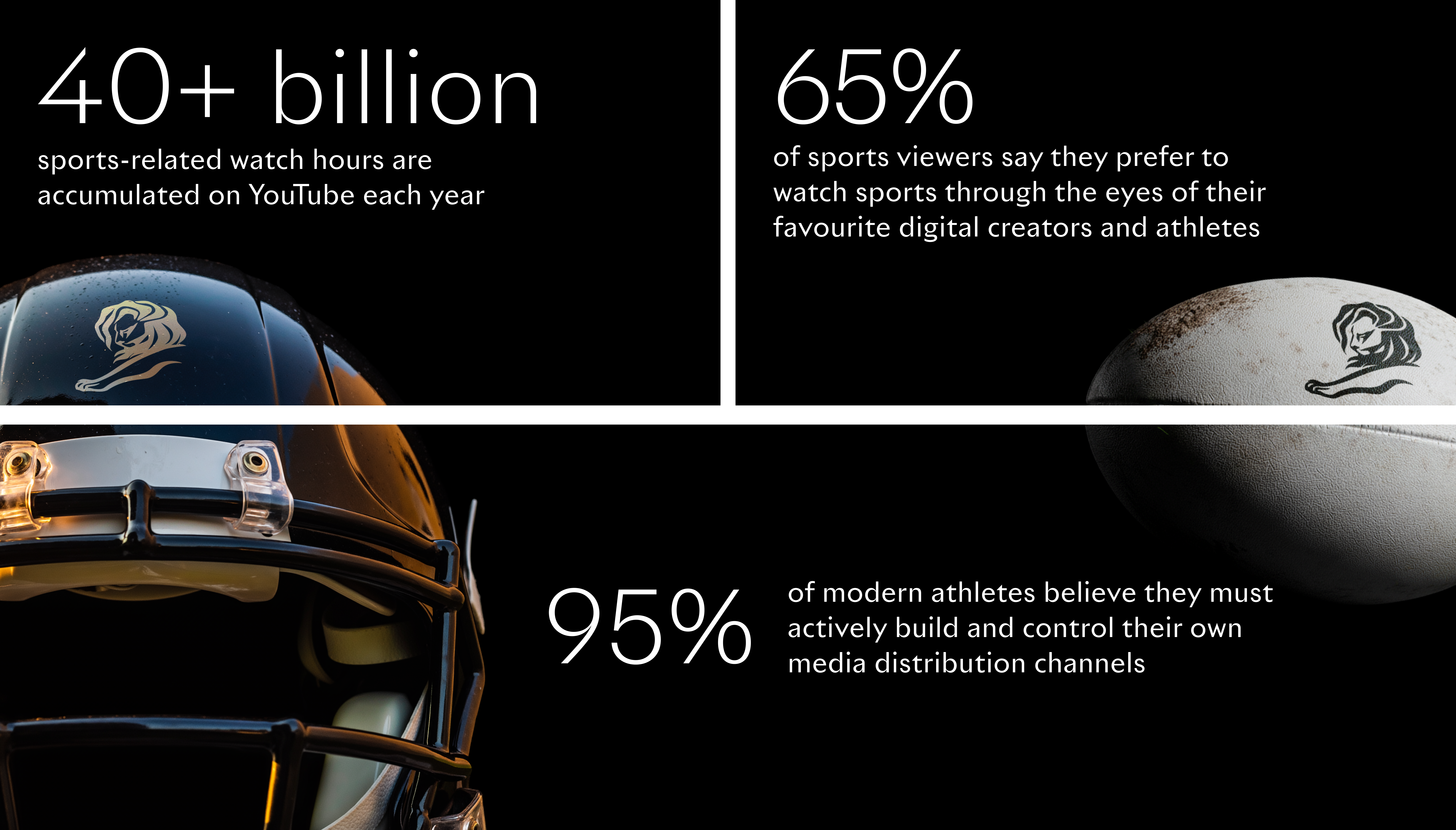
Need-to-know numbers
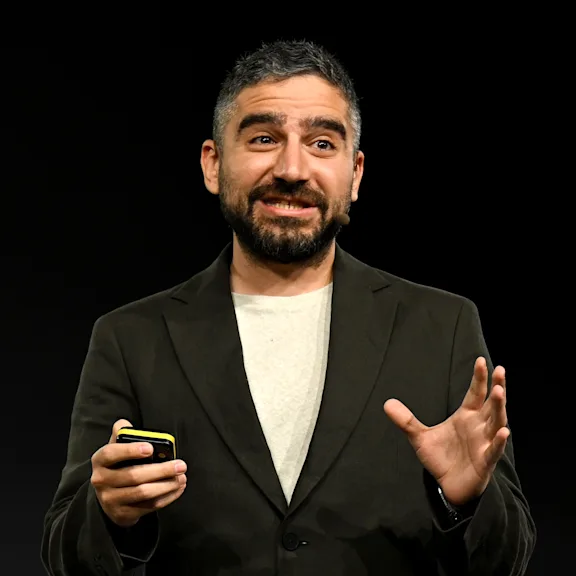
“Fans have no mercy for bad work.”
Mohammed Sehly CEO BigTime Creative Shop
Examples from Lion winners
NBA superstar Kevin Durant’s dry, un-moisturised ankles had been a viral running joke and meme across the internet for five years. Instead of executing a safe, highly polished corporate endorsement deal, CeraVe leaned fully into the banter. The skincare brand officially crowned Durant ‘The New Face of Legs’. The self-deprecating campaign used the meme to highlight a real clinical insight: seven out of 10 men don’t moisturise their bodies. The unscripted authenticity captured 4.1bn PR impressions and helped retail sales jump by 43%. By Beauty Co-Lab, New York, it won a Gold in the Media Lions.
For over two decades, Brazilian World Cup icon Ronaldo’s bizarre ‘triangle haircut’ from the 2002 tournament remained one of football’s most unexplained styling mysteries. Doritos and AlmapBBDO, São Paulo, launched ‘The Triangle Theory’ by leaking a rumour on Reddit from an alleged collector claiming the haircut was actually a triangle designed for an unreleased 2002 Doritos campaign. The internet took the bait, triggering a massive mockumentary-style investigative frenzy across sports shows and social feeds. Teammates, barbers, film directors and even Ronaldo himself joined the playful, character-driven stunt, publicly ‘denying’ the theory while holding a bag of Doritos. The work took home two Lions, including a Bronze in the Entertainment Lions for Sport.
And, of course, there’s Riyadh Season’s ‘Obsession’, for which Riyadh-based BigTime Creative Shop and director Guy Ritchie co-created an unhinged cinematic film in which boxers Tyson Fury and Oleksandr Usyk acted out sleep-deprived fever dreams to a haunting soundtrack. The promo was the most viral boxing ad in history, generating 4.2bn impressions and 12.4m engagements and convincing 30% of viewers to tune in to a boxing match for the first time. It was awarded three Lions, including a Gold in the Entertainment Lions for Sport.
OBSESSION | RIYADH SEASON | BIGTIME CREATIVE SHOP, RIYADH | GOLD, ENTERTAINMENT LIONS FOR SPORT | 2026
